









AI capabilities are creating opportunities for enterprises to launch use cases that promise to improve efficiencies or create new revenue streams. Not all AI, however, is the same, which creates a new challenge: Where should “enterprise AI” as well as other AI workloads be hosted?
Let’s break down the types of AI, what they do and where they are used, with a focus on enterprise AI.
How Widely Is AI Used?
Enterprise AI refers to how businesses integrate AI into technologies and tools to improve productivity, decisions, cost savings, customer experience and innovation. These outcomes are linked to fundamental AI capabilities such as automation, prediction and new content generation.
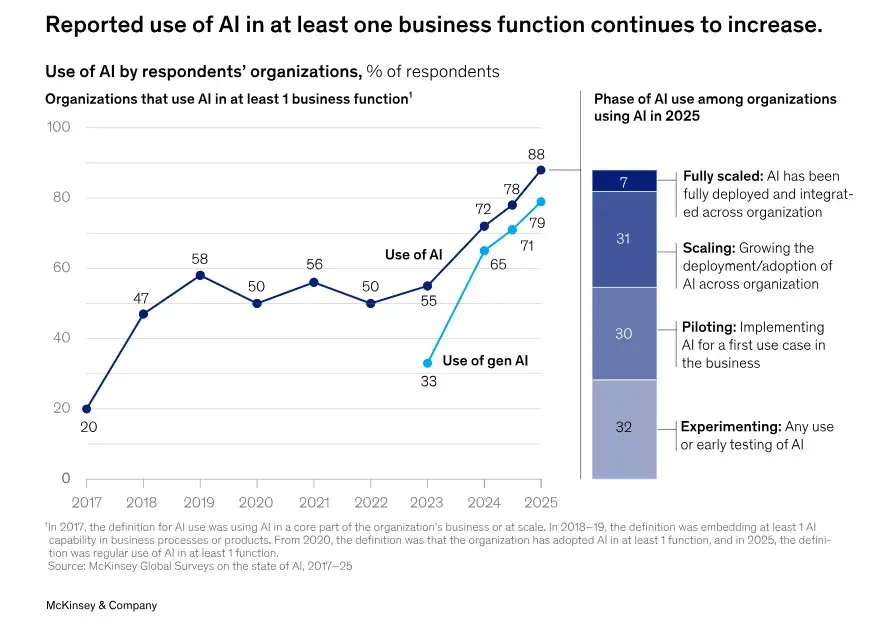
A recent McKinsey survey, The state of AI in 2025: Agents, innovation, and transformation, says that while most organizations are still in the experimentation or pilot phase, 88% of respondents use AI in at least one business function. Only 7% of organizations have “fully scaled” AI, meaning it’s fully deployed and integrated across the business.1
Stanford University’s Artificial Intelligence Index Report 2025 states that “AI is increasingly embedded in everyday life.” Other takeaways are that “business is all in on AI” and 78% of organizations reported using AI in 2024, up from 55% in 2023.2
OpenAI research has an interesting take on adoption. Enterprises are expanding both the extensive margin (more workers adopting AI) and the intensive margin (existing users going deeper). Metrics back up the finding: For example, “75% of workers reported that using AI at work has improved either the speed or quality of their output.”3
The Categories of AI
AI appeared on the scene in the 1950s. Over time, types or levels of AI were named: narrow AI, strong AI, also called artificial general intelligence, and artificial superintelligence.
Narrow AI, the foundation of subsequent AI forms, is the stage we’re in today. Narrow AI requires model training or tuning using massive amounts of data to improve capabilities for a specific task.
Narrow AI simulates intelligence. It doesn’t think on its own, and it’s not capable of reasoning. Narrow AI can be trained to recognize voices, patterns and images, and traditional narrow AI is specialized and used primarily for processing unstructured data that fuels virtual assistants (Siri, Alexa), recommendations systems and facial recognition.
Generative AI (gen AI) is advanced narrow AI. It uses deep learning and neural network techniques and leverages large language models (LLMs) for text, generative adversarial networks (GANs) for images and variational autoencoders for data generation.4
Gen AI capabilities include recognizing patterns, understanding and using natural language during interactions, summarizing text, problem solving, generating new content – text, video, images – and assisting developers with code.
Nearly 80-90% of new use cases are generative AI.
Strong AI and superintelligence don’t exist, but theoretically they could operate independently. Hypothetically, strong AI is human-like in areas such as self-awareness, learning, reasoning, adapting and decision making. Superintelligent AI is more cognitively advanced than humans.
Where AI Lives and Operates
Where AI workloads are hosted depends largely on the intended use, enterprise preferences and regulatory requirements. Here is a high-level breakdown that spans both narrow AI and gen AI:
- Enterprise AI involves local workloads, cloud-based workloads or hybrid workloads. Local workloads run on servers inside enterprise data centers or on the servers of multi-tenant data centers like CoreSite where enterprises “co-locate” in rented space. Enterprises keep workloads local for data privacy, security or latency reasons.
- Enterprises access public or private cloud-based apps and SaaS workloads from their onsite data centers or their spaces in multi-tenant data centers.
- Edge AI runs on devices close to data sources instead of the cloud to support real-time data processing.
- Device AI resides in mobile devices.
- Embedded AI is built into machines and appliances.
Let’s look at examples of narrow AI and gen AI before exploring a few more types of AI that may be less familiar.
Where You’ll Find Narrow AI
Narrow AI is touted mainly for its ability to complete tasks faster and more accurately than humans. The examples below are included because they are still single-purpose, specialized tasks. If you think this comment infers that gen AI is being incorporated into some of the examples, you’re right.
- Cloud platforms such as Amazon’s product recommendation solution and video suggestions on Netflix.
- On-premises and/or cloud-based enterprise software such as medical diagnostic imaging, financial fraud detection, predictive maintenance and cybersecurity.
- Mobile devices that unlock with facial recognition.
- Edge devices such as smart cameras, internet of things (IOT) sensors and industrial robots.
- Embedded AI, which is built into devices or systems. Robots avoid obstacles, for example, and AI diagnoses medical issues from images.
Where You’ll Find Gen AI
Gen AI resides in some of the same places as narrow AI, but think of it as upleveled, with more flexibility and more skills. A few gen AI locations:
- Public clouds such as Microsoft Azure, which hosts enterprise software such as Microsoft Dynamics 365 ERP and CRM applications, or others like Google Cloud and AWS. Data centers, either onsite or multi-tenant, are a conduit for users to access cloud-based AI tools like Google Gemini.
- Laptops, on which some features run locally, but the “brains” are in the cloud for apps like Microsoft Copilot, ChatGPT desktop and Adobe Firefly.
- Smartphones, like laptops, offer hybrid gen AI apps for things like translation, image generation and voice assistance. The Siri digital assistant processes requests on the device whenever possible but can use cloud-based LLMs when necessary.5
Tools like ChatGPT and Google process billions of queries daily.
Other Forms of AI: Some Older and Some Newer
Now that we’ve covered the narrow AI and gen AI basics, let’s look at other forms of AI that use or leverage narrow AI and/or gen AI. Advanced AI systems can combine multiple types of AI.
Agentic AI
Agentic AI systems are designed to work autonomously to pursue their assigned goals. Enterprises can build, deploy and manage AI agents with tools available in leading public clouds. AI agents can make decisions about what to do and how to do it by following multiple steps using tools and APIs and coordinating work with people or other agents. Agentic AI resides in some of the usual locations:
- Cloud, to enable enterprise AI meeting assistants or deploy agents in security operations centers to conduct cybersecurity threat detection and response. Some AI functions, like audio and video capture, might run locally on laptops or phones.
- Edge, to support autonomous vehicles and drones.
- On devices, like robots, where agents control physical actions.
74% of companies plan to deploy agentic AI within two years.
Deloitte
Multimodal AI
Multimodal AI (narrow AI or gen AI depending on its design) understands and processes multiple types of data simultaneously – text, images, audio, video and so on. ChatGPT-4 and Google Gemini are multimodal designs that live in cloud platforms, and enterprises can tap their capabilities to create content, analyze videos, chat and so on.
Physical AI
Physical AI controls machines or robots that interact with the physical world, compared to AI that exists (virtually) only in software or digital environments. Initially built decades ago using narrow AI, some modern systems incorporate gen AI, deep learning and multimodal capabilities:
- The robots in manufacturing and warehouse facilities for assembly line work, quality inspection and other tasks.
- Autonomous vehicles for which AI detects pedestrians, lanes, traffic signs and more and processes data from cameras, sensors and radar.
- Edge computing systems that enable drones to inspect utility power lines, oil and gas pipelines and roofs/properties for insurance purposes.
58% of companies already use physical AI to some extent…setting the pace for the next wave of industrial automation.
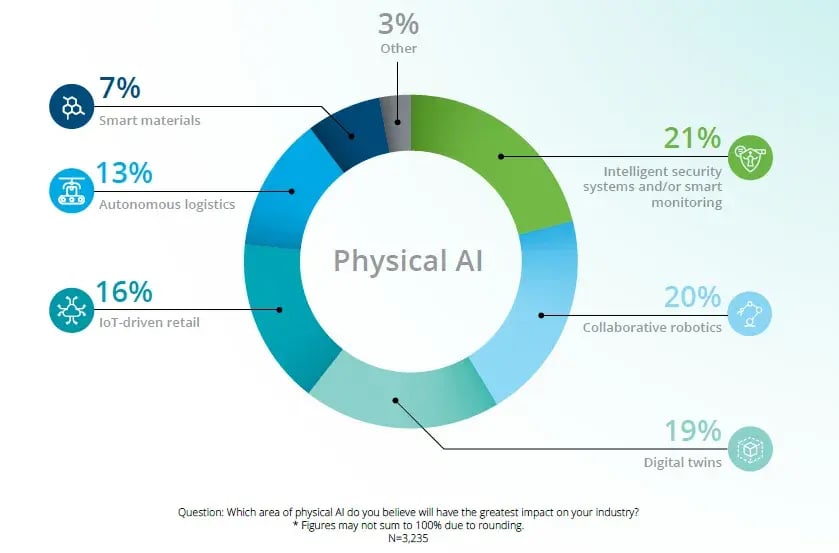
Source: Deloitte
Collaborative AI
Collaborative AI assists humans as experts in drudgery. What else would you call repetitive tasks or scanning financial transactions to find potential fraud or analyzing data to predict inventory requirements? Typically, collaborative AI is narrow AI designed to focus on collaboration, but some systems incorporate gen AI for reasoning or other capabilities. Where collaborative AI lives:
- On devices. In partially autonomous vehicles, the AI takes over routine tasks like keeping vehicles in the lane and providing adaptive cruise control.
- In the cloud. The AI in Microsoft Copilot, for example, makes suggestions about writing and editing.
- At the edge. Autonomous forklifts in manufacturing or warehouse facilities can maintain safety and avoid collisions by processing incoming data in real time.
- In a hybrid approach. In coding, the combination of cloud, edge and/or on-device depends on which tools developers use, how much computing horsepower the AI application needs and whether it can tolerate latency.
Sovereign AI
Sovereign AI is a service – typically involving gen AI – that operates within the borders of a nation to ensure compliance with local data privacy laws, governance and regulations.6 A McKinsey expert describes it as “the intelligence layer that you build on top of your data.”7 The intent of sovereign AI is to control the entire AI lifecycle, the intelligence, the hardware, data and infrastructure to reduce dependencies on foreign vendors and potential adversaries.
77% of companies say the location of AI development is a key factor when choosing new technologies, signaling that geographic sovereignty is now as important as innovation.
AI, a Force Multiplier for Humans
Now that we’ve arrived at the end of this succinct overview of enterprise AI, Bill Bryson’s “A Short History of Nearly Everything” comes to mind. Short is relative. AI isn’t everywhere, yet, but enterprises are implementing AI in many use cases.
Where AI lives and works depends on myriad factors, including latency, computing power, data storage, regulations, bandwidth and maintenance. Industry experts sometimes call AI a force multiplier to help humans be more productive and effective – not to mention challenged, entertained, informed and inspired.
Learn More
Check out the links below to learn more about AI or visit the Knowledge Base.
- ICertGlobal, What Is Narrow AI? (source)
- Microsoft, How Does Generative AI Work (source)
- IBM, AI Agents in 2025: Expectations Vs. Reality (source)
- Stanford, AI Experts Predict What Will Happen in 2026 (source)
- Medium, AI Series Part 3: The Three Waves of AI (source)
%20copy.webp)
References
- McKinsey, The State of AI in 2025: Agents, Innovation and Transformations, November 5, 2025 (source)
- Stanford University, Artificial Intelligence Index Report 2025 (source)
- OpenAI, The State of Enterprise AI, December 8, 2025. (source)
- CEO Today, Top 7 Emerging AI Technologies to Watch, April 28, 2025 (source)
- Cyber Magazine, How Apple Is Using Siri to Protect User Data, January 15, 2025 (source)
- TechTarget, Sovereign AI Explained: Everything You Need to Know, July 29, 2025 (source)
- McKinsey, What Is Sovereign AI, March 6, 2026 (source)