








It won't surprise you to find that AI’s impact on power and cooling is the hot data center topic for 2026. Accenture describes the state of the data center industry: “In 2026, the sector faces unprecedented momentum – driven by surging demand for AI, cloud, edge computing and the relentless pursuit of speed, efficiency and sustainability.”1
What might surprise you are the potential solutions to the challenges the surge in demand for AI creates. In this blog, we present some of the expert opinions covered in APMdigest’s 2026 Data Center Predictions, which includes thoughts on how data center providers could shift their infrastructure to address customer needs.
Geography and On-Site Power
“In 2026, power becomes the defining intersection of AI growth and data center operations,” says Shane Snider from Data Center Knowledge. “Data centers are shifting from passive energy consumers to grid stakeholders – co-investing in infrastructure upgrades, enabling load flexibility, and deploying on-site power generation and storage to improve reliability and manage costs.”2
Geography will be an important consideration. Matt Kelly, CTO and VP of Technology Solutions at the Global Electronics Association, says, “Data center geography will become a strategic advantage as operators prioritize locations with abundant, cost-efficient energy and reliable cooling capacity.”3 While it doesn’t get much press, free cooling – pulling cool air from outside the data center into the air circulation system – is a very cost-effective, green cooling solution, which can be factored into the decision on data center location.
Data center operators also are expected to increase behind-the-meter power arrangements, according to the 2026 Global Data Center Outlook from JLL.4 We explored several such technologies in a past blog, More Power! Behind-the-Meter Power Systems for Data Centers, where we discuss options ranging from fuel cells to small nuclear reactors.
Natural Gas: The Bridge to Renewables?
Experts are expecting natural gas to be a key solution to the data center power issue, at least in the short term. The JLL report says natural gas could play a role in alleviating grid constraints in the U.S.4 “One of the arguments for turning to natural gas is that it allows a more reliable power source, given the fluctuating load demands of AI power centers [e.g. data centers] and variable power from renewable energy sources,” according to the Data Centre Trends Report 2026 from Soben, a part of Accenture.5
The move toward natural gas does not exclude renewable energy, however. JLL says it is worth noting that some of the largest data center tenants are averse to natural gas solutions because they are not viewed as sustainable.4 For this reason, natural gas may serve more effectively as a temporary bridge to renewable energy sources. The Soben report adds that some data center operators are also looking to hybrid solutions, which combine renewable energy and natural gas as a “Power Couple.”5
Liquid Cooling Goes Mainstream
“As vital to the future of AI as the advancement of chips is the evolution of cooling technology for those chips; higher processing capacity and denser racks create greater quantities of heat,” states the Soben report. “With cooling systems specialists, hyperscalers and chip manufacturers hard at work on R&D programs to find new solutions, 2026 could be the year of a major breakthrough.”5
Experts expect liquid cooling to ramp up this year. Kelly of the Global Electronics Association says AI’s power and thermal requirements will make liquid cooling mainstream. Christopher Tozzi, Technology Analyst, supports this prediction: "In addition to consuming lots of power, AI workloads generate a lot of heat, which is why one AI trend that may play out over the coming year is growing adoption of liquid cooling systems. Not only are these systems more efficient, but they may also be the only way to cool AI servers that run so hot that conventional cooling methods can’t keep up.”6
Angela Taylor, Chief of Staff and Head of Strategy at Liquid Stack adds that modularity will be key to scaling liquid cooling in AI data centers. “As AI workloads continue to drive power densities ever higher, data center operators will seek out more powerful, modular liquid cooling systems that can be easily deployed and scaled incrementally as thermal regulation needs grow. By late 2026, expect to see skidded, modular units starting at 2MW (and reaching well beyond) become the de facto models for high-density data center builds.”3
Taylor also predicts that new two-phase direct-to-chip cooling solutions will be announced in 2026, becoming the successor to today’s one-phase liquid cooling systems as rack densities climb up to and beyond one megawatt.3
Focus on Costs: Data Center vs. Cloud
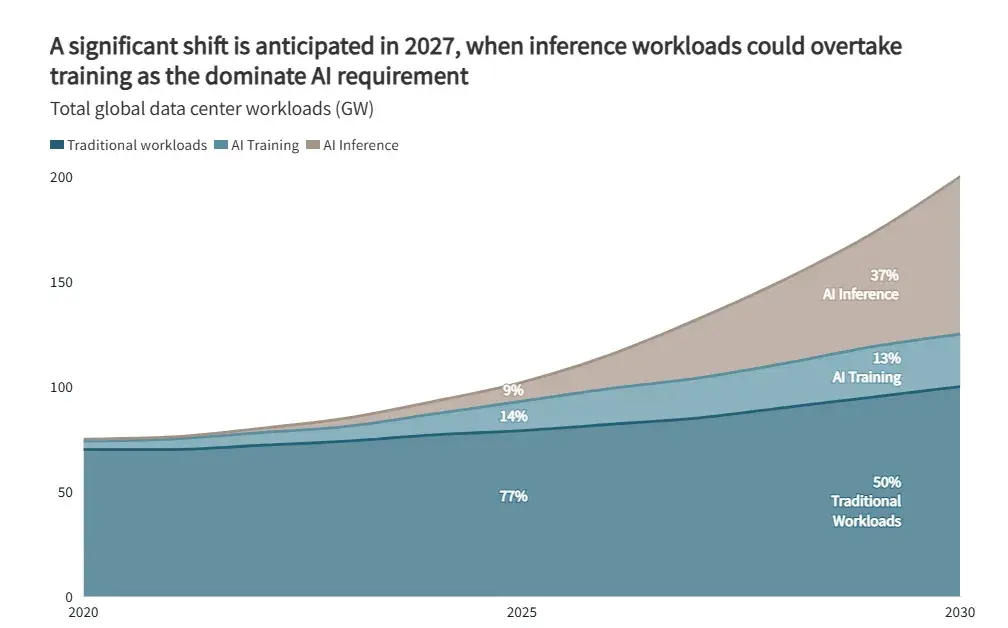
AI is also driving a new focus on cost optimization, encouraging companies to explore a repatriation strategy. John Kindervag, Chief Evangelist at Illumio believes enterprises will be “ditching the cloud, moving data back to data centers” for select workloads.3
The “trillion-dollar paradox,” as Andreessen Horowitz described it, is forcing business leaders to face a hard truth. "The cloud's convenience often hides long-term cost and control tradeoffs," Kindervag explains, adding, “The agility that once justified the cloud premium has become a drag on profitability.”3
Kindervag also thinks organizations will move back to the data center to use private large language models, due to fears that proprietary data in the cloud will be consumed by public LLMs.3
Rather than completely repatriating workloads, however, enterprises likely will pursue a hybrid approach. “The next phase of cloud adoption will look more balanced,” Kindervag continues. “Companies will keep what makes sense in the cloud and bring home the workloads that do not. Many will take a hard look at what they are paying for and what they gain in return, then move critical systems back into environments they can fully control. This shift will create more hybrid models that help organizations cut waste, tighten security and make more informed decisions about where to store their most sensitive data based on cost, performance and regulatory needs.”3
Some experts see this as part of a growing commitment to more cost-effective use of data center resources. Karthik Sj, GM of AI at Logic Monitor, says the idle GPU epidemic will ignite an industry-wide awakening in 2026. “The question will no longer be how much compute you own but how intelligently you orchestrate it. Enterprises will use AI-first observability to maximize ROI from every watt, workload and chip. The winners will transform underused data centers into self-optimizing ecosystems that drive autonomous growth and regenerative impact.”3
Williamson of Myth Worx agrees, "The next race won’t be for the biggest model or the most GPUs, it’ll be centered on performance per watt. Efficiency will be the new barometer, and the companies that can deliver powerful AI at a fraction of today’s energy cost will be the ones that remain on top.”3
A New Era for Data Centers
While AI will clearly present several challenges that data centers must face, most experts agree that AI is also propelling the data center industry into a new era of massive growth in 2026. The exponentially increasing demand for AI compute power translates to greater demand for data center capacity. The JLL report concludes, “The data center sector currently sits at the beginning of one of the largest infrastructure investment supercycles seen in the modern era. The interconnected nature of data centers means the AI-fueled expansion is reshaping a number of sectors including power, technology and real estate.”

Know More
Visit CoreSite’s Knowledge Base to learn more about the ways in which data centers are meeting constantly increasing power and other infrastructure requirements.
The Knowledge Base includes informative videos, infographics, articles and more, all developed or curated to educate. This digital content hub highlights the pivotal role data centers play in transmitting, processing and storing vast amounts of data across both wireless and wireline networks – acting as the invisible engine that helps keep the modern world running smoothly.
References
1. Data Center Trends 2026: Shifting up a gear, Accenture, January 6, 2026 (source)
2. 2026 Predictions: AI Sparks Data Center Power Revolution, Shane Snider, Senior News Writer, Data Center Knowledge, January 7, 2026 (source)
3. 2026 Data Center Predictions, APMdigest, January 14, 2026 (source)
4. 2026 Global Data Center Outlook, JLL (source)
5. Data Centre Trends Report2026, Soben, Part of Accenture, October 13, 2025 (source)
6. The AI Infrastructure Revolution: Predictions for 2026, Christopher Tozzi, Technology Analyst, Data Center Knowledge, January 5, 2026 (source)