






Data centers are built to meet the demand for “digital everything,” but their role in our lives isn’t always well-understood. Without data centers, life as we know it would be radically different. Consumers, businesses and governments rely on data centers and their infrastructures, which enables digital services for texting, emailing, banking, shopping, internet searches, 911 call centers, gaming and many other activities.
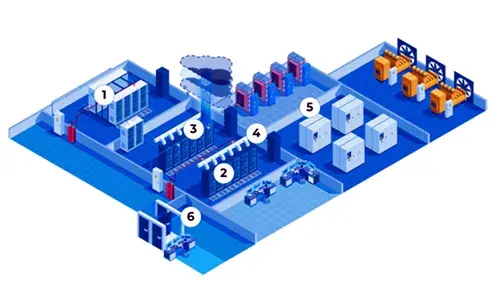
What is a data center?
A data center is a building within which equipment processes, stores, transmits and manages data. Each data center operator provides the infrastructure (including the power, cooling and networking systems) that supports the digital interactions, communications and services the equipment enables.
What are the different types of data centers?
Data centers differ in size, capabilities and purpose. The most well-known types are hyperscale, multi-tenant colocation and enterprise on-premises. Emerging types are edge and modular. According to Data Center Frontier, hyperscalers control 44% of global capacity and are projected to reach 61% of capacity by 2030.1
Hyperscale
- Built by or for technology companies such as Meta, Oracle, Google Microsoft and Amazon.
- Usually contain a single tenant that owns or leases a facility that provides massive compute power.
Multi-Tenant Colocation
- A facility owned and operated by a data center company in which tens-to-hundreds of businesses (tenants) rent space to locate and operate IT equipment.
- Tenants share resources and costs, and they receive centralized monitoring and management capabilities, connectivity options and can take advantage of scalability.
Enterprise On-Premises
- A facility owned and controlled by a private business for its own use — can be a small room, a building or a campus.
- Data remains onsite or within the business systems, often to comply with data privacy requirements.
Edge
- A small facility located on the edge of a network, close to end users.
- Can operate with low latency, the time required for data to travel from its source to a processing location. Some applications need lower latency than is possible for a trip to the cloud or an on-premises data center and back, making edge data centers a viable option for specific applications.
Modular
- A portable, plug-in method of creating data center capacity with prefabricated modules that include equipment, security, power and cooling.
- Suitable for companies to start small and grow and for edge computing and incremental capacity for other types of data centers.
What drives data center growth and value?
The data center industry is subject to a fundamental economic principle: supply increases to meet demand. The collective, pervasive use of digital services by consumers, businesses and governments drives data center growth. Virtually all digital/online activity runs through data centers.
Almost half of the people in the United States spend 5 to 6 hours on smartphones daily.2
Data centers serve as the backbone of digital services globally – facilitating the super-fast communications and transactions we’ve come to expect. But data centers also contribute to the economy and communities. They create jobs, stimulate tech investments and generate tax revenue. PWC found that during 2017 to 2023, each direct job in the data center industry supports more than six jobs elsewhere in the U.S. economy and, in total, the data center industry’s tax contribution to federal, state and local governments amounted to $715.5 billion.3
As shown in the table, different types of data centers support different types of digital services, although there is overlap in some areas. Please note: This list is not comprehensive and constantly evolving.
| Hyperscale | Multi-Tenant Colocation | Enterprise On-Premises | Edge | Modular |
|
- AI model training - Gaming - Cloud: data bases, DevOps, IoT, social networks -Data analytics - AI model hosting - Chip development - Cloud availability zones |
- Providing access to public and private clouds for myriad organizations, enabling email, text, GPS, emergency 911 services, medical research, gaming, internet searches, etc. - AI inference/AI-enabled business applications like chat bots, financial services, data analytics and content streaming |
- Sensitive, classified or proprietary data such as customer data, financial information, software code - Use cases requiring real-time quality control such as manufacturing processes - Legacy workloads that are not cloud-compatible |
- Local data processing - Real-time data processing for use cases such as smart city applications, smart homes, robotics, health monitoring, traffic management - AI inference |
- Rapid setup for disaster recovery or temporary, rural or incremental IT operations - Edge-to-5G use cases (e.g. wireless to wireline convergence) - IoT - AI-enabled business applications |
Why do businesses choose multi-tenant colocation data centers?
Multi-tenant colocation data centers appeal to businesses that want to find the right solution given their IT strategy, budget, location, staffing, workloads and other factors.
Today, enterprises running hybrid IT maintain data centers on-premises and colocate some core business operations (including AI inferencing) or use colocation to store data. Small and start-up businesses find it easier and less expensive to colocate than to build and run a data center onsite.
McKinsey forecasts that global demand for data center capacity
could more than triple by 2030; about 70% will come from hyperscalers.4
Colocation facilities can offer flexible options to customize each tenant’s space and resources. Also, colocation customers (tenants) share costs for IT infrastructure, power, cooling, bandwidth, security and monitoring; another economic principle applies here - economies of scale. Additionally:
- Businesses can access the cloud service providers directly (if the provider has that capability) and reduce data egress fees while bypassing the internet.
- Interconnection capabilities enable and simplify collaboration among enterprises, telecommunication companies, cloud service providers, AI companies, internet exchanges, IT systems integrators and other organizations (entities that comprise digital ecosystems).
- Scalability options allow tenants to adjust resources to meet seasonal business needs, spikes in demand and growth.
Where does artificial intelligence fit in the demand for data centers?
According to industry experts, demand for AI tools and capabilities is a top cause of data center growth. Again, supply rises to meet demand. McKinsey forecasts that “demand for AI-ready data center capacity will rise at an average rate of 33% a year between 2023 and 2030.”5 AI is present in our lives, whether we know it or not, as you can see from the examples in the table.
| Consumer Use of AI | Business Use of AI | Government Use of AI |
|
- AI tools like ChatGPT, Copilot and Gemini - Navigation services like Waze, Google Maps and Apple Maps - Personalized recommendations from Spotify, Netflix and Amazon |
- Customer service chatbot, targeted ads and digital assistants - Zoom, Microsoft Teams and other unified communications solutions - Recognizing out-of-the-ordinary patterns that indicate a potential problem in product quality, security, safety, financial transactions, etc. |
- 911/emergency response - Public health oversight - Fraud detection - Cybersecurity |
Threads of the AI story include AI model training and AI inference. Generative AI models like ChatGPT, Gemini and Claude are trained with data, images, videos and software algorithms that help the models learn how to inference. Training requires enormous computing power, so a good deal of AI training happens in hyperscale data centers. However, colocation data centers can be used for model tuning, private AI model training and inference; much like the evolution of the cloud, where AI happens depends on the environment best suited for the workload.
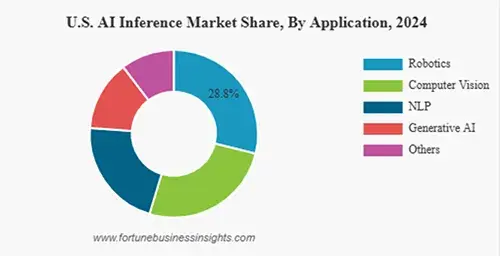
AI inference is the “doing” part of artificial intelligence. It’s the moment a trained model stops learning and starts working,
turning its knowledge into real-world results.6
Source: Fortune Business Insights
After training, a model is ready to be used for AI inference — the real-world use of AI to answer questions, recognize patterns, make predictions, draw conclusions and assist with complex decision making. AI “infers” a conclusion based on what it has learned during training. For example, self-driving cars use AI inference to recognize traffic signs (stop!) and predict the behavior of other vehicles to avoid contact (brake!). Other inference use cases7:
- Fraud detection in financial services, which flags and blocks suspicious activity.
- Recommendation engines personalize the experience of retail shoppers in real time.
- Disease diagnosis based on AI models viewing X-rays and scans.
- Predictive maintenance recommendations based on AI models analyzing sensor data in production equipment.
AI inference requires less computing power than AI training, so any type of data center potentially can run AI inference. We already see quite a bit of AI inference in our facilities and expect the volume to increase, given rapid growth.
Find out how CoreSite pioneers AI inference zones, which enable data centers to support real-time AI.
What do data centers do for us and the economy?
Data centers contribute more to the economy than many people realize. The headline of a recent Fortune article reads, “Without Data Centers, GDP Growth Was 0.1% in the First Half of 2025.” The article goes on to say that U.S. GDP growth in the first half of 2025 was almost entirely driven by investment in data centers and information processing technology.8 An Urban Land Institute report includes this list of data center benefits – a lot to think about as we go about our day:
- Protecting the privacy of data within U.S. borders against cyber threats.
- Hosting critical infrastructure for emergency services.
- Supporting healthcare such as telehealth visits and records management.
- Enabling banks and other financial entities to conduct daily operations.
- Supporting the development of emerging technology, much of which involves AI.
- Contributing to our competitiveness in the global economy.
- Providing access to supercomputer processing and secure cloud storage, leveling the playing field for small and large businesses.9
What is the future of data centers?
No crystal ball here, but what we know is that data centers are woven into the fabric of modern society. We rely on data centers for everyday and critical digital services. As digital services continue to expand, so will data centers.
Ideally, everyone involved — data center builders and operators, data center tenants, data center associations, communities, state and local governments, public service commissions, energy companies and policy makers — will work together to provide education, address issues and ensure transparency.
Know More
Visit CoreSite’s Knowledge Base to learn more about the ways in which data centers are meeting clients’ constantly increasing power and other infrastructure requirements.
The Knowledge Base includes informative videos, infographics, articles and more. This digital content hub highlights the pivotal role data centers play in transmitting, processing and storing vast amounts of data across both wireless and wireline networks – acting as the invisible engine that helps keep the modern world running smoothly.
References
1. Data Center Frontier, AI Supercharges Hyperscale: Capacity, Geography and Design Are Being Redrawn, August 6, 2025 (source)
2. DemandSage, Latest Smartphone Usage Statistics (2025 Data & Trends), October 23, 2025 (source)
3. PWC, Economic Contributions of U.S. Data Centers, 2017-2023 (source)
4. McKinsey, The Data Center Balance: How U.S. States Can Navigate the Opportunities and Challenges, August 8, 2025 (source)
5. McKinsey, AI Power: Expanding Data Center Capacity to Meet Growing Demand, October 29, 2024 (source)
6. Google, What Is AI Inference (source)
7. SUSE, AI Inference : Everything You Need to Know, November 10, 2025 (source)
8. Fortune, Without Data Centers, GDP Growth Was 0.1% in the First Half of 2025, Harvard Economist Says, October 7, 2025 (source)
9. Urban Land Institute, Local Guidelines for Data Center Development, 2024 (source)